







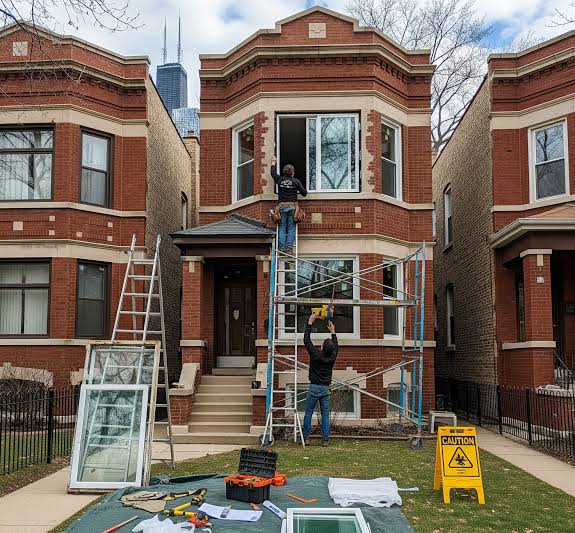
There’s a particular sound that Chicago winters make when your windows are ageing. It isn’t dramatic. No shattering, no obvious failure. Just a low, consistent draught — the kind that creeps around the edges of the frame at two in the morning, nudging you awake without ever announcing itself. You pull the duvet a little tighter. You assume it’s fine. Most people assume it’s fine for years.
That assumption costs more than most homeowners realise.
In the Chicago metropolitan area and the surrounding Chicagoland suburbs — where winters genuinely test infrastructure and summers push air conditioning to its limits — windows and doors are not cosmetic decisions. They’re functional ones. And the gap between a well-installed, properly insulated window and one that’s simply still hanging in the frame is measurable in monthly utility bills, indoor air quality, and a quality of sleep that people don’t connect to glazing until they’ve lived through both.
What the draught is actually telling you
The thing about deteriorating windows and doors is that they rarely fail completely. Instead, they decline in ways that are easy to rationalise. The frame swells a little in summer, sticks a little in winter. There’s condensation between the panes — but only sometimes. The lock doesn’t feel quite right, but it still catches. So you adjust. You put a draught excluder along the bottom. You keep a jumper near the sofa in December.
What you’re actually doing is managing symptoms of a structural problem rather than addressing it.
Older windows and doors in Chicagoland homes — particularly those built in the mid-20th century, or those that went through a single low-budget update decades ago — frequently operate with compromised seals, degraded framing materials, or glazing that simply wasn’t designed for modern thermal performance. The insulation value, measured in U-factors, drops significantly over time. What that means practically is that your heating system runs harder than it needs to, your cooling cycles more frequently than it should, and your indoor temperature never quite stabilises.
Energy bills don’t spike dramatically enough in any single month to force the conversation. They just sit slightly higher than they ought to. Over a decade, that’s a substantial figure.
The comfort question people don’t think to ask
Homes that perform well thermally feel different in ways that are difficult to articulate until you’ve experienced the contrast. Rooms stay at a consistent temperature rather than shifting depending on proximity to external walls. There’s no cold radiation from glazing in January. Sound attenuation improves — the din of traffic, neighbours, the general noise of suburban and urban life — becomes noticeably quieter. Modern double and triple-glazed units with quality frames handle this considerably better than older single-pane or basic double-glazed equivalents.
Security is another layer of this conversation that tends to get left out. Doors in particular — front entries, patio sliders, French doors leading to rear gardens — are the most common points of residential vulnerability. Not because most homeowners are complacent, but because the lock quality and frame integrity of older installations simply weren’t built to modern standards. Multipoint locking systems, reinforced frames, and impact-rated glazing aren’t features that older doors typically offer.
When people come to think seriously about upgrading, they often describe a moment of recognition: the existing setup was never really adequate. It was just familiar.
Why professional installation matters more than the product
This is where the conversation gets more nuanced. The window and door market is crowded. There are entry-level options, mid-range options, premium options. And a significant portion of homeowners make the mistake of assuming that the product itself determines the outcome.
It doesn’t. Not entirely.
A high-performance window incorrectly installed — with inadequate flashing, poor sealing around the rough opening, or misaligned frames — will underperform. Draughts will return. Moisture will infiltrate. The thermal break that makes modern glazing effective gets partially undone by the gaps that sloppy installation leaves behind. Chicagoland’s climate is particularly unforgiving about this: the freeze-thaw cycle is severe enough to exploit any installation weakness within a few seasons.
Professional installation, by contrast, accounts for the specific conditions of the home — the age of the framing, the type of siding, the orientation of the opening, the existing drainage plane. It takes longer. It costs more upfront. And it performs correctly for the duration of the window or door’s lifespan, which, with quality products and quality installation, can comfortably exceed twenty years.
For homeowners weighing the decision, you can learn more about the benefits of upgrading residential windows and doors by visiting this detailed guide to professional windows and doors replacement for comfortable living in Chicagoland https://ftevent.it.com/professional-windows-and-doors-replacement-for-comfortable-living-in-chicagoland/.. — which covers the practical considerations specific to the region in more depth.
The timing people get wrong
Most homeowners make this decision reactively — after a particularly brutal winter, or after spotting visible rot in a frame, or after a door starts refusing to latch properly. That’s understandable. But it means the replacement often happens under some pressure, which affects both the quality of the decision and the pace at which it gets made.
The better approach is to treat it as a planned capital improvement rather than an emergency repair. Assess windows and doors in their entirety rather than one unit at a time. Understand what’s actually functioning at an adequate level and what’s merely holding on. Get quotes with enough lead time to make a considered selection rather than simply taking whoever can come quickly.
The payback period on quality window and door replacement — accounting for energy savings, reduced maintenance, and the increase in property value — is well established. But it only materialises when the work is done properly.
What doesn’t change
None of this is especially complicated. Homes need to perform well. Chicagoland winters are not hypothetical. The gap between windows and doors that are genuinely sound and those that are gradually failing tends to widen quietly, for a long time, before anyone addresses it.
The draught at two in the morning is telling you something. Most people just need to decide when they’re ready to listen.